
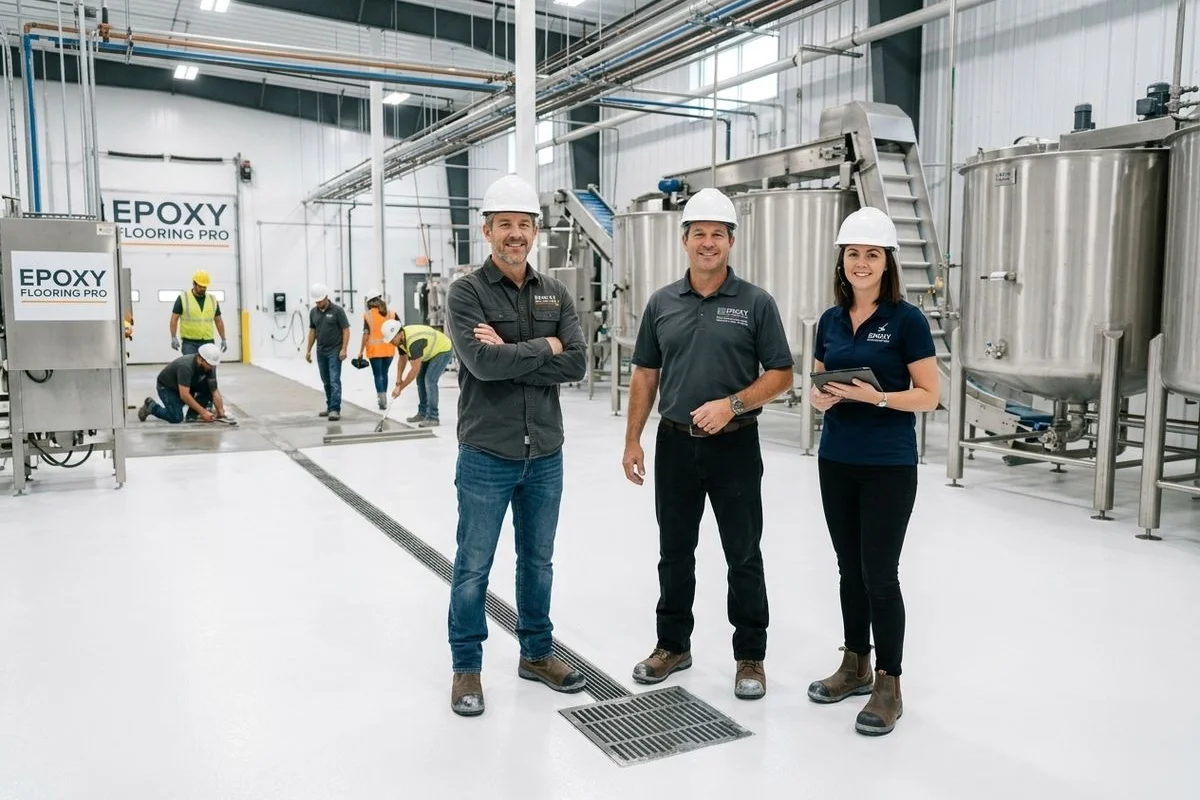
Food-Grade Floor Systems in Warren, MI
HACCP-certified, USDA and FDA approved floor systems for Warren's food distribution, cold storage, and processing facilities. Thermal shock resistant urethane cement across Macomb County.
Food-Grade Flooring for Warren’s Distribution and Processing Sector
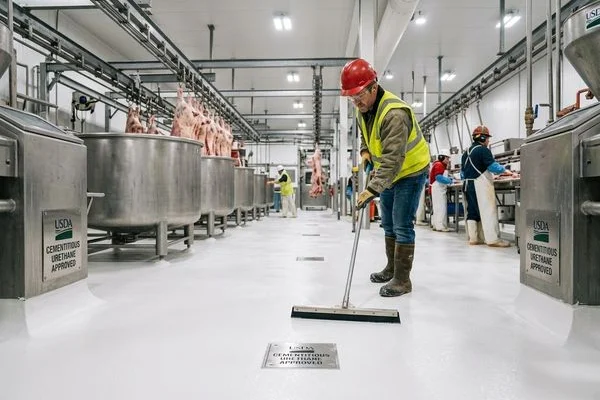
Warren’s food distribution industry — anchored by Lipari Foods’ 237,000 SF headquarters, distribution center, and separate 252,000 SF freezer warehouse — represents one of Southeast Michigan’s most concentrated clusters of food-grade flooring demand. These facilities handle products that require USDA, FDA, and HACCP compliance, and their floors endure conditions that destroy standard coatings within months: sub-zero freezer temperatures cycling to ambient, aggressive sanitizer wash-downs, organic acid exposure from food products, and constant forklift traffic hauling pallets across wet processing zones.
Epoxy Flooring Pro installs food-grade floor systems engineered for these exact conditions. Our USDA-approved, HACCP-certified urethane cement and epoxy systems deliver thermal shock resistance, antimicrobial performance, and the seamless, non-porous surfaces that food safety auditors require — across Warren’s food distribution, cold storage, and processing facilities.
Why Standard Epoxy Fails in Warren’s Cold Storage and Food Facilities
Standard bisphenol-A epoxy is the workhorse of industrial flooring — but it has documented limitations that make it inappropriate for the wet, temperature-cycling environments found in Warren’s food distribution sector. The failure modes are predictable and well-understood:
Thermal shock cracking: When a freezer door opens and -20°F air hits an epoxy floor rated for 50°F minimum service temperature, the thermal differential causes the coating to crack. In Warren’s food warehouses where doors cycle dozens of times daily — and loading docks are exposed to Michigan’s winter temperatures — this cycling is constant and destructive.
Moisture vapor delamination: Warren’s high water table and spring thaw cycles drive significant moisture through concrete slabs. Standard epoxy traps this moisture, creating osmotic blistering. Southeast Michigan’s soil conditions make this problem more acute than in drier regions.
Chemical attack from organic acids: Meat juices, dairy products, and vegetable acids are mildly corrosive to standard epoxy chemistry. In a distribution environment where spills are daily occurrences, the cumulative acid contact deteriorates the coating.
Urethane cement systems address every one of these failure modes with fundamentally different chemistry.
Urethane Cement: The Correct Specification for Warren’s Food Facilities
Urethane cement mortar systems bond to the concrete substrate at a molecular level — creating a composite layer that moves with the slab through thermal cycling rather than cracking away from it. For Warren’s food distribution and cold storage operations, this chemistry delivers:
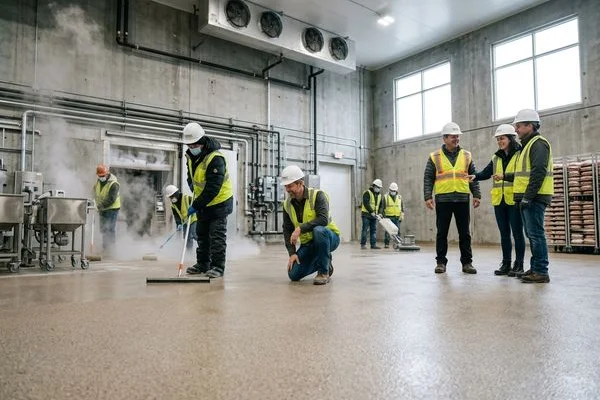
- Thermal shock resistance rated to 250°F continuous service — handles steam cleaning followed by freezer exposure without cracking
- Thermal cycling tolerance — critical for Warren loading docks exposed to Michigan winters while connected to heated warehouses
- High moisture vapor tolerance — can be installed on slabs with up to 25 lbs/1,000 SF/24hr emission rates, addressing Southeast Michigan’s high water table
- Chemical resistance to organic acids, fats, CIP chemicals, and aggressive sanitizers used in food distribution
We regularly specify urethane cement for wet processing and cold storage zones in Warren food facilities, combined with 100% solids epoxy systems in dry production, office, and warehousing areas of the same project.
Zone-by-Zone Specification for Complex Warren Food Facilities
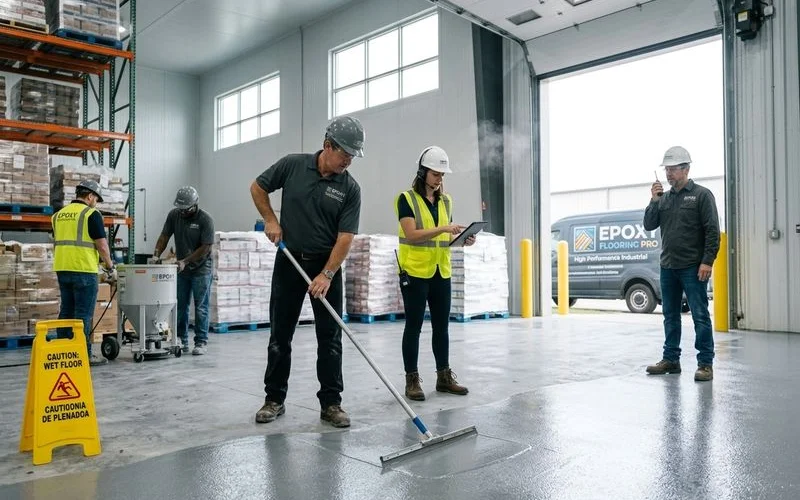
Large food distribution and processing facilities in Warren rarely have uniform floor conditions. A facility like Lipari Foods’ campus has distinct zones — each requiring different flooring properties:
Freezer and cold storage zones: Urethane cement mortar at 1/4-inch minimum thickness, rated for thermal cycling from -40°F to ambient. Non-porous, seamless surface with antimicrobial additive.
Wet processing and wash-down areas: Urethane cement with integral coved skirting at all wall junctions. Sloped to drain at minimum 1.5% grade. Non-slip aggregate broadcast for worker safety in wet conditions.
Dry warehousing and distribution: 100% solids epoxy flooring with high-build topcoat for abrasion resistance under constant forklift traffic. Color-coded zone marking for OSHA compliance.
Loading docks and receiving areas: Urethane cement or heavy-duty epoxy rated for Michigan’s extreme temperature range. Non-slip texture for workers moving between trucks and warehouse.
Office and break areas: Standard epoxy or decorative systems appropriate for light traffic.
Coved Skirting: The Detail That Determines Audit Results
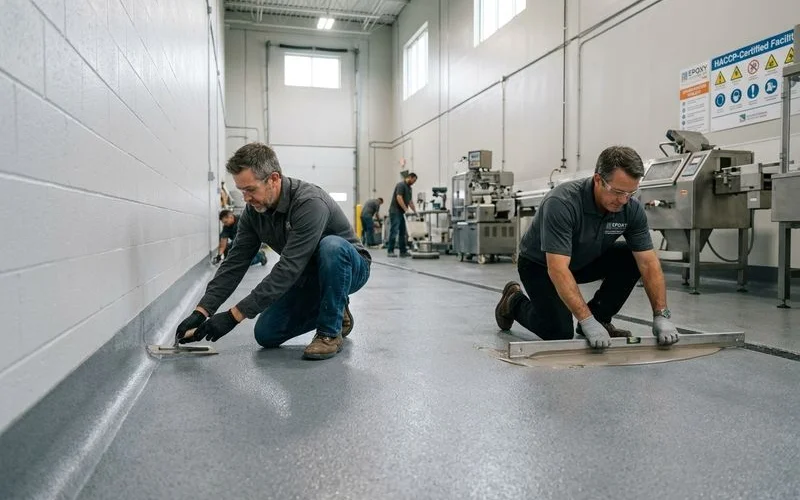
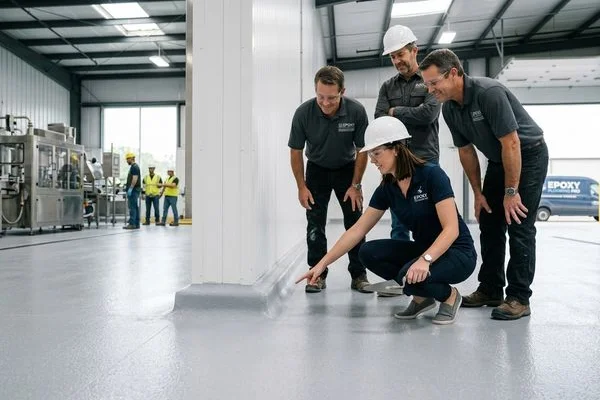
In food facility flooring, the coved skirting detail at wall-to-floor transitions determines whether your facility passes or fails food safety audits. A square-profile joint between floor and wall creates a 90-degree corner where organic material, moisture, and bacteria accumulate — exactly the harborage point that USDA inspectors and SQF auditors are trained to identify.
Our coved skirting transitions use the same floor system material formed into a smooth radius at every wall, column, and equipment base junction. The result is a fully seamless, monolithic surface from floor to wall that can be pressure-washed clean with no crevices for bacterial growth. In Warren’s food distribution facilities where HACCP audits are a regular occurrence, this detail directly impacts your compliance status.
Compliance Documentation for Warren Food Facilities
Food-grade floor installations require more than quality work — they require documented evidence of compliance. For every Warren food facility project, we provide:
- Product data sheets confirming USDA/FDA approval status for all materials used
- Application records with lot numbers, batch quantities, and cure conditions
- Moisture vapor emission test results (ASTM F1869 / F2170)
- Photographic documentation of all installation stages
- HACCP-aligned installation protocol records
- Final inspection confirmation with film thickness measurements
This documentation package supports your HACCP audit records, SQF certification, and USDA inspection requirements.
Serving Warren’s Growing Food Distribution Sector
Warren’s food distribution sector continues to grow. Lipari Foods’ ongoing expansion, Gordon Food Service’s retail presence, and the broader trend of food logistics centralization in Macomb County mean increasing demand for food-grade flooring that meets USDA, FDA, and HACCP standards. Whether you operate a cold storage warehouse, a food distribution center, or a processing facility in the Warren area, our team has the specialized knowledge to specify and install the correct floor system for your compliance requirements.
Contact our estimating team to schedule a facility assessment and receive a zone-by-zone specification for your Warren food facility.
What's Included
Our Food & Beverage Flooring Installation Process
Facility Assessment and Compliance Review
Our project team conducts a detailed facility assessment covering zone classification (wet/dry, processing/non-processing), drain locations and flow patterns, temperature exposure ranges including steam cleaning and CIP cycles, chemical exposure profile (sanitizers, acids, fats), and existing floor condition. We document regulatory requirements applicable to your facility type before specifying any system.
Zone-Specific System Specification
Food facilities rarely have uniform conditions throughout. Wet processing areas, refrigerated zones, dry storage, receiving docks, and employee welfare areas each require different system properties. We develop a zone-by-zone specification that applies the appropriate product in each area — urethane cement in steam-cleaned wet zones, 100% solids epoxy in dry production areas, anti-slip broadcast systems in high-traffic pedestrian zones.
HACCP-Protocol Surface Preparation
All surface preparation in food production facilities follows HACCP-aligned protocols. Equipment is cleaned between operations to prevent cross-contamination. Shot blasting equipment is containerized to control media. All chemical prep materials are food-safe rated. Substrate moisture and pH are documented. The preparation area is kept isolated from active food production zones throughout the project.
Drain and Cove Installation
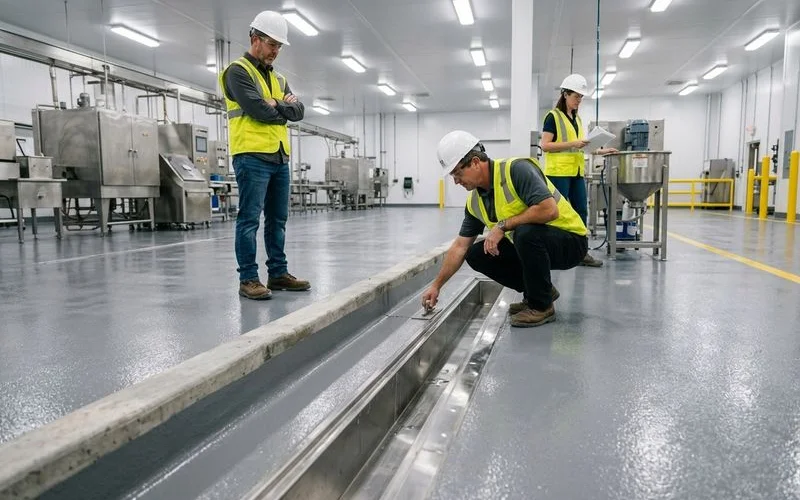
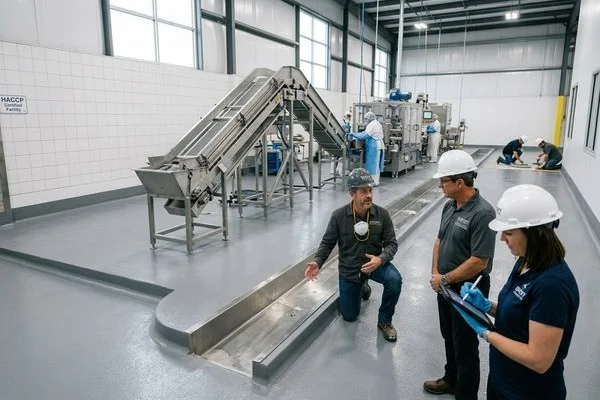
Drains are properly integrated into the floor system with sloped transitions that direct water to drains without pooling. Coved skirting at all wall, column, and equipment base junctions is installed using the same floor system material, creating a fully seamless, cleanable transition that eliminates the harboring areas that grow microorganisms in conventional square-profile floor-wall junctions.
Primary System Application
The primary floor system is applied following manufacturer protocols for temperature, humidity, and pot life. Food-grade pigments and antimicrobial additives are blended at factory-verified concentrations. Film thickness is monitored at each stage and documented. All application equipment is maintained clean and free of contaminants throughout the installation.
Compliance Documentation and Inspection
Upon completion, we provide a full compliance package including product data sheets confirming USDA/FDA approval status, application records with lot numbers and batch quantities, photographic documentation of all stages, moisture testing records, and inspection confirmation. This documentation supports your HACCP audit records and facility certification requirements.
Why Choose Epoxy Flooring Pro
Food Safety Protocol Training
Our crews who work in food and pharmaceutical facilities complete food safety awareness training before entering any food-contact area. We understand HACCP principles, GMP requirements, and how installation activities must be managed to avoid contaminating food production environments.
Approved Product Inventory
We maintain an inventory of USDA/FDA-approved coating systems from multiple manufacturers, ensuring product availability and the ability to match the right system to your specific facility requirements.
Cove and Drain Expertise
Coved skirting and drain integration are the highest-failure-risk details in food facility flooring. Our crews are specifically trained and practiced in these details.
Thermal Shock Testing
We only specify systems with documented thermal shock resistance tested to the actual temperature ranges in your facility. Many epoxy products claim chemical resistance but are not rated for the 50–200°F thermal cycling common in food processing environments.
Experience Across Food Sectors
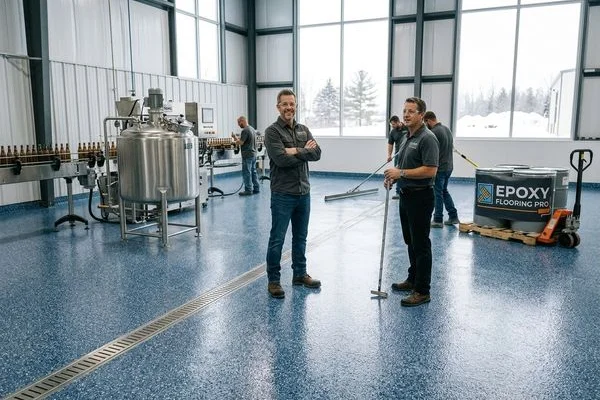
We have installed food-grade floor systems in meat processing, poultry processing, dairy production, beverage manufacturing, commercial bakeries, pharmaceutical production, and institutional kitchens.
Project Gallery
Before & After
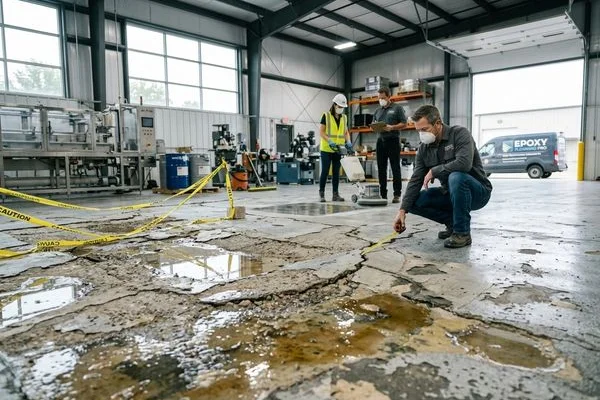
Before
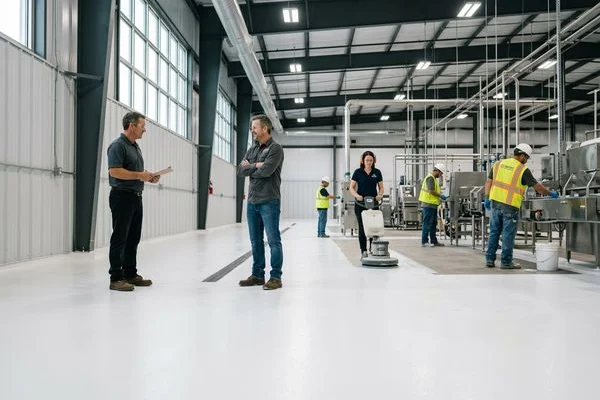
After
What Our Clients Say
"Our Warren cold storage facility processes food products that go from -20°F freezer to ambient loading dock temperatures daily. The urethane cement system Epoxy Flooring Pro installed handles the thermal shock without any cracking or delamination. Our HACCP auditor specifically noted the quality of the coved skirting transitions."
"We needed USDA-compliant flooring in our food distribution warehouse near I-696. Epoxy Flooring Pro understood our regulatory requirements from day one, specified the correct system, and completed the installation during our scheduled shutdown. Zero floor-related audit findings since installation."
"The coved skirting detail is everything in a food facility. Epoxy Flooring Pro's crew was meticulous about every cove transition in our Warren processing area. Our SQF auditor specifically commented on the quality of the floor installation."
Frequently Asked Questions
Why do Warren's food facilities need specialized flooring?
Why is urethane cement preferred over epoxy in food processing areas?
Can food-grade flooring be installed during partial facility operation?
What antimicrobial options are available for Warren food facilities?
How do you handle floor-to-drain transitions in food facilities?

Get a Free Estimate for Food & Beverage Flooring
Our project managers are ready to assess your facility and recommend the optimal food & beverage flooring solution.