
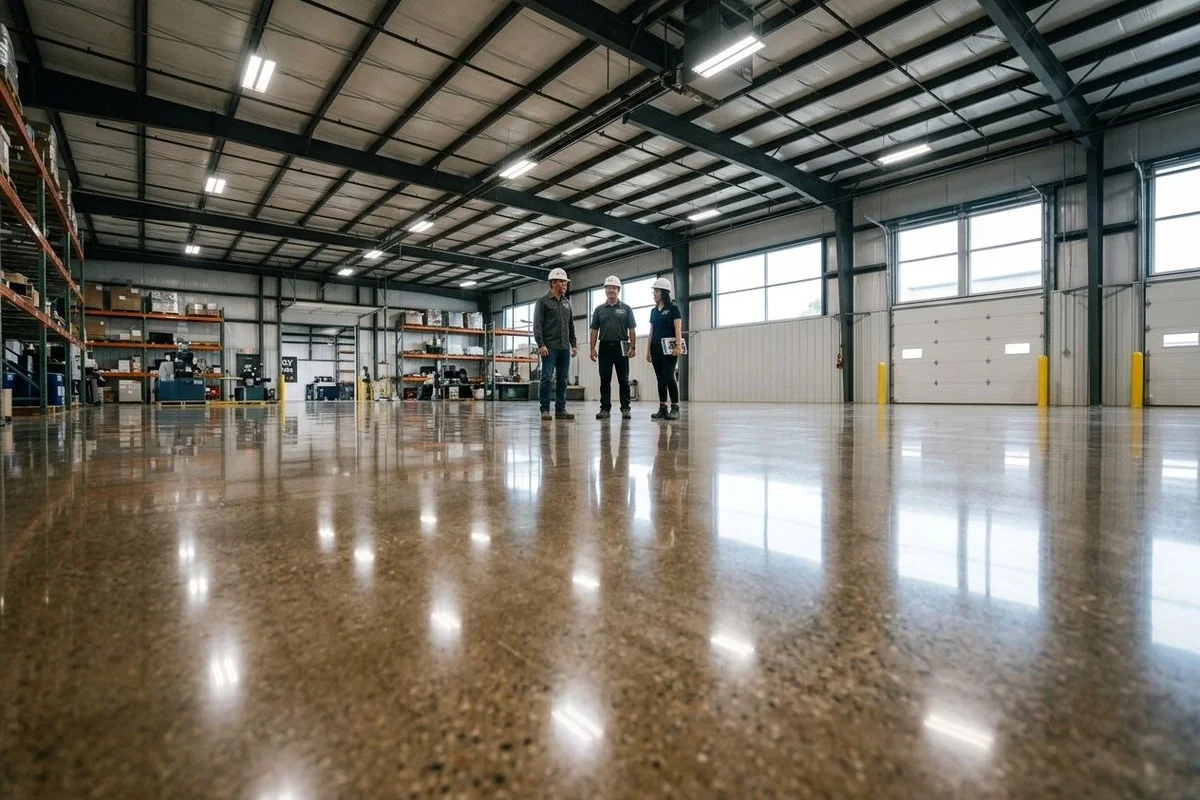
Polished Concrete Flooring in Warren, MI
Mirror-finish polished concrete and diamond grinding for Warren's commercial showrooms, distribution centers, and industrial facilities. Durable, low-maintenance flooring across Macomb County.
What Polished Concrete Actually Is — and Why Warren Facilities Are Choosing It
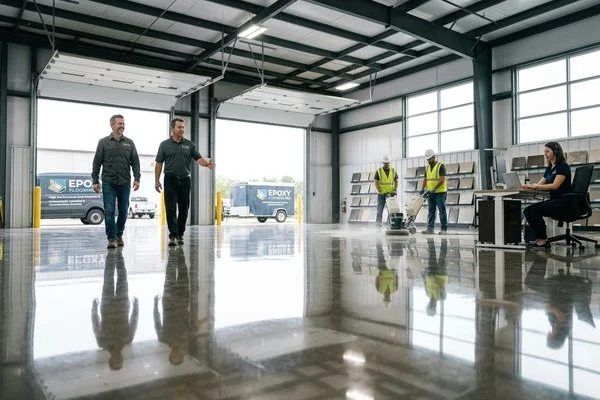
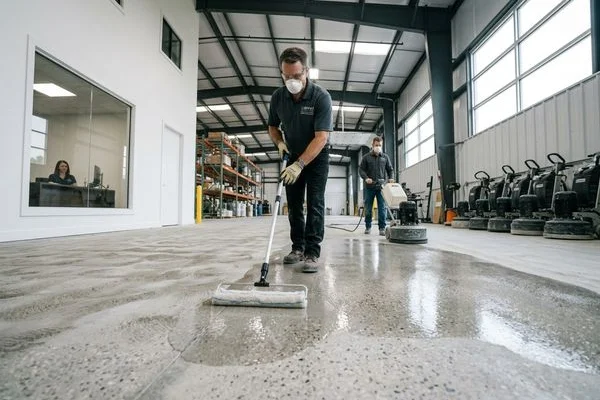
Many contractors in the Warren market offer “polished concrete” that is actually a thin topical coating over ground concrete — a coating that peels, scratches, and requires replacement. True polished concrete is a mechanical and chemical process that permanently modifies the concrete slab itself. No topical coating is applied. The final surface IS the concrete — hardened, refined, and polished to a brilliant finish.
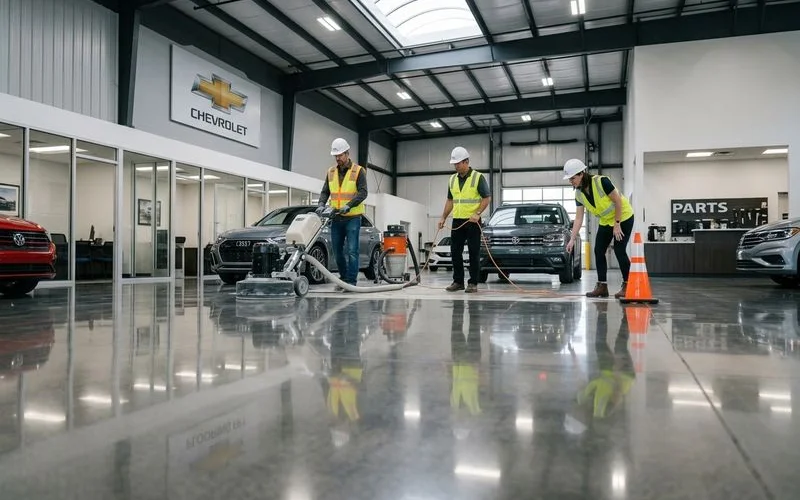
Warren’s commercial landscape makes it an ideal market for polished concrete. Auto dealership showrooms along Van Dyke and M-53 want high-gloss mirror finishes. Distribution centers at the Mound Road Industrial Park need durable, low-maintenance floors that handle constant forklift traffic. Retail spaces across Macomb County want aesthetics without ongoing coating maintenance cycles.
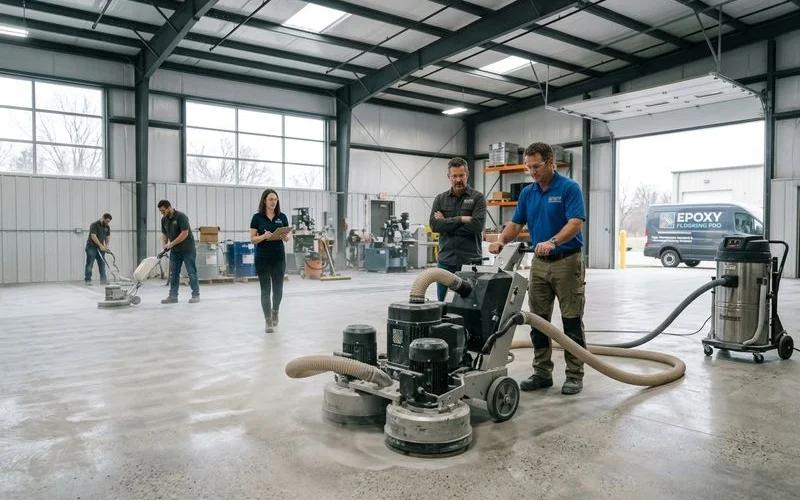
Epoxy Flooring Pro performs genuine mechanical polishing using planetary diamond tooling and penetrating chemical densifiers. The result is a floor that cannot peel, cannot delaminate — even through Southeast Michigan’s punishing freeze-thaw cycles — and improves in surface hardness over time.
The Science Behind Diamond Polishing and Densification
Understanding the process explains why polished concrete outperforms coated alternatives for the right Warren applications.
Diamond Tooling Sequences
Diamond-impregnated tooling is categorized by bond type (metal, transition, resin) and grit size. Metal-bond tooling at coarse grits (16–50) cuts aggressively, removing the soft carbonated layer, surface defects, and prior coatings to expose fresh, hard concrete. Many older Warren industrial slabs from the 1950s–1970s manufacturing era have excellent aggregate that produces stunning polished results once the deteriorated surface layer is removed.
The bond chemistry must match the concrete hardness. Soft concrete requires harder bond to expose fresh diamond; hard concrete requires softer bond. Mismatching tooling to concrete hardness is a leading cause of poor polish results — a common problem when residential-focused contractors attempt commercial polishing.
Densifier Chemistry
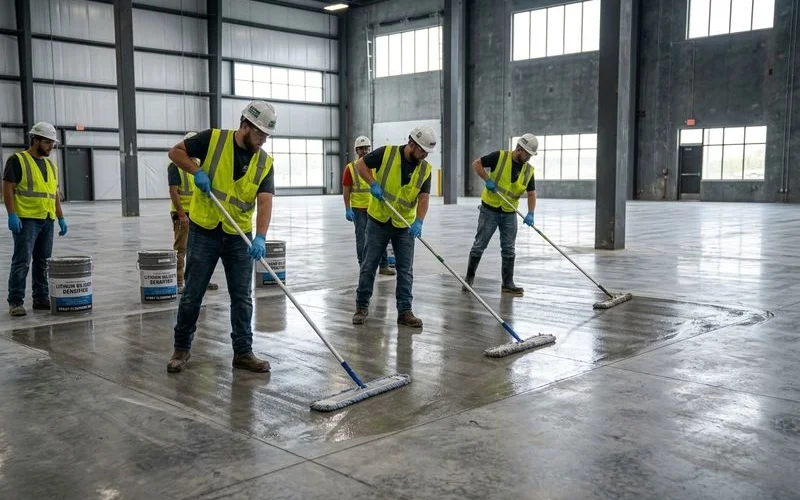
Liquid silicate densifiers penetrate the open concrete pores and react with calcium hydroxide — a byproduct of cement hydration — to form additional calcium silicate hydrate (CSH). This is the same compound that gives concrete its strength, so densification essentially continues the concrete’s internal curing chemistry.
The practical result: the surface becomes harder, denser, and more abrasion-resistant. For Warren warehouses with heavy forklift traffic and distribution facilities handling thousands of pallet moves daily, this hardness translates directly to longer floor life.
Aggregate Exposure Options for Warren Projects
One of the most significant aesthetic decisions is aggregate exposure level. Warren’s concrete slabs typically contain river gravel aggregate from Southeast Michigan sources, which can produce attractive polished results:
Cream Finish (Level A): Grinding removes only surface laitance. Polished surface shows fine aggregate and cement paste. Popular for commercial offices and retail.
Salt-and-Pepper Finish (Level B): Light grinding exposes tips of coarse aggregate. Shows a blend of cement matrix with occasional aggregate. The most popular finish for Warren industrial and retail applications.
Medium Aggregate Exposure (Level C): Approximately one-third of coarse aggregate diameter exposed. Distinctive terrazzo-like appearance with visible stone.
Full Aggregate Exposure (Level D): Major grinding reveals full coarse aggregate. Often called a “decorative terrazzo” look. Results depend heavily on aggregate distribution in the original mix.
We review samples from your actual slab to set realistic expectations before specifying exposure level.
Where Polished Concrete Performs Best in Warren
Polished concrete is not right for every Warren facility — it excels where its unique characteristics align with operational needs:
Ideal Warren applications:
- Distribution centers at Mound Road Industrial Park and Warren Commerce Center
- Automotive dealership showrooms along Van Dyke Avenue and M-53
- Retail spaces and commercial buildings throughout Macomb County
- Light manufacturing areas with clean, dry operations
- Healthcare facility common areas and corridors
- Office buildings and corporate spaces near the I-696 corridor
Applications to evaluate carefully:
- Areas with frequent chemical spills or wet cleaning (guard treatment required)
- Food processing wet zones (urethane cement or epoxy is typically superior — critical for Warren’s food distribution facilities)
- Areas with oil contamination deeply embedded in the slab (common in older Warren automotive plants)
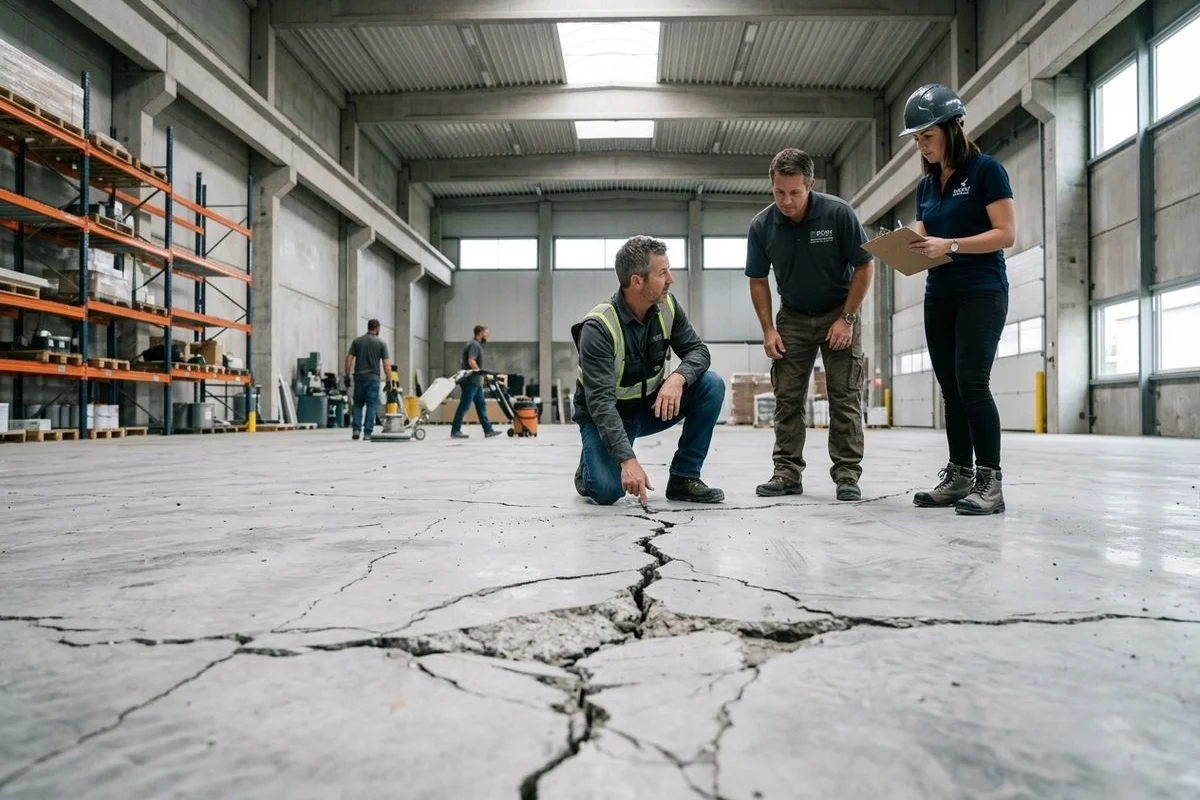
- Slabs with extensive structural cracking (concrete repair work required first)
Guard Treatments: Stain Protection for Warren’s Active Facilities
The final step in our polished concrete systems is a penetrating guard treatment. Unlike topical sealers that sit on the surface as a film, penetrating guards soak into the polished pores and chemically bond:
- Oil and stain resistance — handles automotive fluids in showrooms, food spills in retail, and cleaning chemical exposure
- Reduced maintenance effort — most spills bead up and wipe clean
- Preservation of the polished sheen — no haze or yellowing from UV exposure
- Long service life — 3–5 years before reapplication under normal Warren facility conditions
We carry multiple guard formulations including fluoropolymer-based guards for maximum chemical resistance and water-based guards for VOC-sensitive environments.
Maintenance: The Long-Term Advantage for Warren Facilities
The true value of polished concrete becomes apparent in the maintenance phase — especially for Warren facility managers tired of epoxy coating replacement cycles every 7–10 years:
- Daily cleaning: Dry micro-fiber dust mop or auto-scrubber with pH-neutral cleaner
- Spill response: Wipe immediately — guard treatment slows penetration significantly
- Avoid: Harsh acid or alkali cleaners, steel-pad autoscrubbers
- Periodic: Re-buff with fine diamond pads annually; reapply guard every 3–5 years
No recoating cycles. No coating removal. No weeks of production interruption. Your Warren facility’s floor simply gets better with each maintenance polishing cycle as the surface continues to harden.
Contact our estimating team to schedule a concrete assessment at your Warren facility and discuss the finish levels achievable on your specific slab.
What's Included
Our Polished Concrete Installation Process
Concrete Assessment & Profiling
We evaluate the slab's hardness (Mohs scale), flatness, aggregate exposure level, existing cracks and joints, and any contamination. This assessment determines the starting grit metal-bond tooling and the target finish level achievable on your specific slab.
Coarse Metal-Bond Diamond Grinding
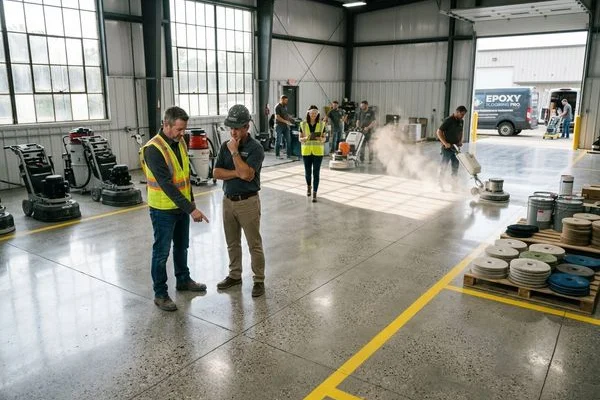
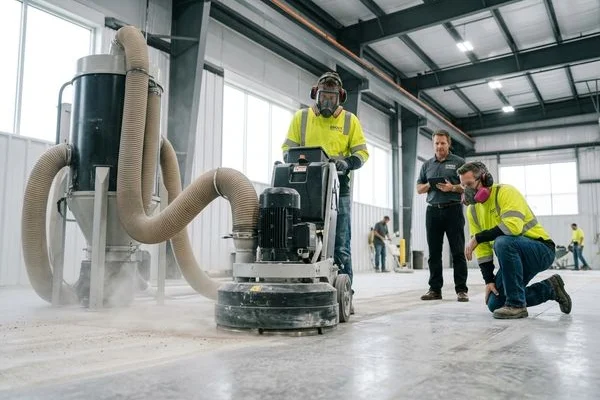
Starting with 16–30 grit metal-bond diamond tooling, we remove surface laitance, lippage, old adhesives, and minor surface irregularities. For aggregate-exposure finishes (salt-and-pepper, full aggregate), additional passes at lower grits open the surface further.
Progressive Diamond Polishing
Sequential passes through 50, 100, 200, and 400 grit tooling refine the surface profile with each step. The floor transitions from rough-ground concrete to an increasingly smooth, uniform surface. Transition-bond and resin-bond tooling is used in the middle and upper grits.
Chemical Densifier Application
A lithium or sodium silicate densifier is applied and worked into the surface between polishing stages. The densifier reacts with calcium hydroxide in the concrete matrix to form calcium silicate hydrate — hardening the surface, sealing the pores, and significantly increasing abrasion resistance.
Fine Polishing to Specified Sheen
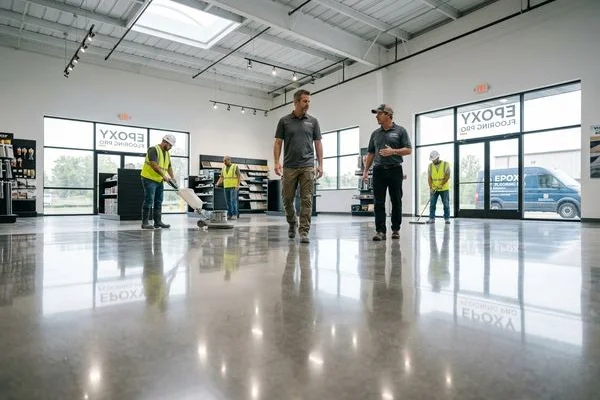
Polishing continues through 800, 1500, and up to 3000 grit resin-bond tooling to achieve the specified sheen level. A 400 grit finish produces a flat matte; 800 grit gives a satin sheen; 1500–3000 grit delivers a mirror-bright high-gloss surface.
Guard Sealer Application
A penetrating guard treatment — not a topical coating — is applied to provide stain resistance for oils, food acids, and cleaning chemicals. The guard maintains the polished look while providing surface protection without any film to peel or re-apply.
Why Choose Epoxy Flooring Pro
Planetary Grinder Fleet
We operate a full fleet of planetary head grinders from 10-inch single-head to 32-inch dual-planetary machines. Planetary grinding ensures flat, level results — orbital or single-head machines create swirl patterns and uneven profiles that are visible in the final finish.
Validated Densifier Chemistry
We use colloidal silica and lithium silicate densifiers from proven manufacturers, applied at validated coverage rates. Under-application of densifier is a common industry shortcut that compromises hardness and dustproofing — we measure application rates on every project.
Consistent Cross-Training
Every crew member is trained on all phases — grinding, densifying, polishing, and guarding. This cross-training eliminates hand-off errors and ensures the crew managing your final polish understands the substrate conditions established during coarse grinding.
Detailed Project Documentation
We provide written documentation of all grit sequences used, densifier application rates, cure times, and final sheen readings. This record is invaluable for maintenance planning and future repair coordination.
Post-Installation Maintenance Programs
We offer annual maintenance polishing and guard reapplication programs to preserve the floor's appearance and performance over time — ensuring your investment looks exceptional for decades.
Project Gallery
What Our Clients Say
"We converted our Warren auto dealership showroom to 3000-grit polished concrete. The mirror finish reflects the lighting perfectly and customers notice it immediately. Over a year of daily traffic and it still looks incredible. The guard treatment handles the occasional oil drip without any staining."
"Our distribution center off I-696 had worn epoxy that kept failing. Epoxy Flooring Pro recommended polished concrete — no more coatings to peel off. The satin finish handles forklift traffic daily and the light reflectivity improved our warehouse visibility noticeably."
"We needed 20,000 sq ft of polished concrete for our Sterling Heights retail space. The crew was methodical and professional, delivered exactly the salt-and-pepper finish we asked for, and finished on schedule. Maintenance is a fraction of our old tile floor."
Frequently Asked Questions
Is polished concrete practical for Warren's industrial warehouses?
How does polished concrete hold up in Michigan's climate?
How does polished concrete compare to epoxy in total cost of ownership?
What finish levels do you offer for Warren commercial spaces?
Can older Warren industrial slabs be polished successfully?
Get a Free Estimate for Polished Concrete
Our project managers are ready to assess your facility and recommend the optimal polished concrete solution.