
Non-Slip Safety Coatings for Slippery Industrial Floors in Warren, MI
Eliminate workplace slip hazards in Warren's manufacturing plants, food facilities, and warehouses with non-slip coatings, aggregate broadcast systems, and verified COF testing.
Slip-and-Fall Injuries Are Preventable — But Only If the Floor Is Correct
Slip-and-fall accidents are the second leading cause of workplace injuries and fatalities in the United States, according to the Bureau of Labor Statistics. In Warren’s industrial and commercial environments — where wet floors, spilled oils, coolant from automotive manufacturing, cleaning chemicals, and constant pedestrian and forklift traffic combine — a smooth floor surface is not just uncomfortable; it is a documented hazard that creates OSHA compliance liability and real risk of serious injury.
The frustrating reality is that many Warren industrial floor coating projects are specified and installed without any consideration for slip resistance. A new, smooth epoxy floor looks professional and clean on installation day. On the first morning it is wet from a cleaning cycle, an oil leak from a hydraulic press, or water tracked in through a Mound Road loading dock during a Michigan winter, it can become dangerously slippery — and the facility’s safety record reflects that.
Epoxy Flooring Pro installs non-slip floor coating systems that deliver measured, documented slip resistance for the specific conditions of your Warren environment — wet, oily, chemical-contaminated, or all of the above.
How Slip Resistance Is Created in Floor Coatings
Slip resistance in a coated floor surface is a function of surface texture at the microscopic and macroscopic level. A completely smooth floor coating provides minimal grip for footwear, especially when wet or contaminated with the oils and coolants common in Warren’s automotive manufacturing operations. Creating usable friction requires introducing surface irregularities — either through aggregate particles embedded in the coating or through a textured topcoat formulation.
Aggregate Broadcast Systems: Maximum Performance
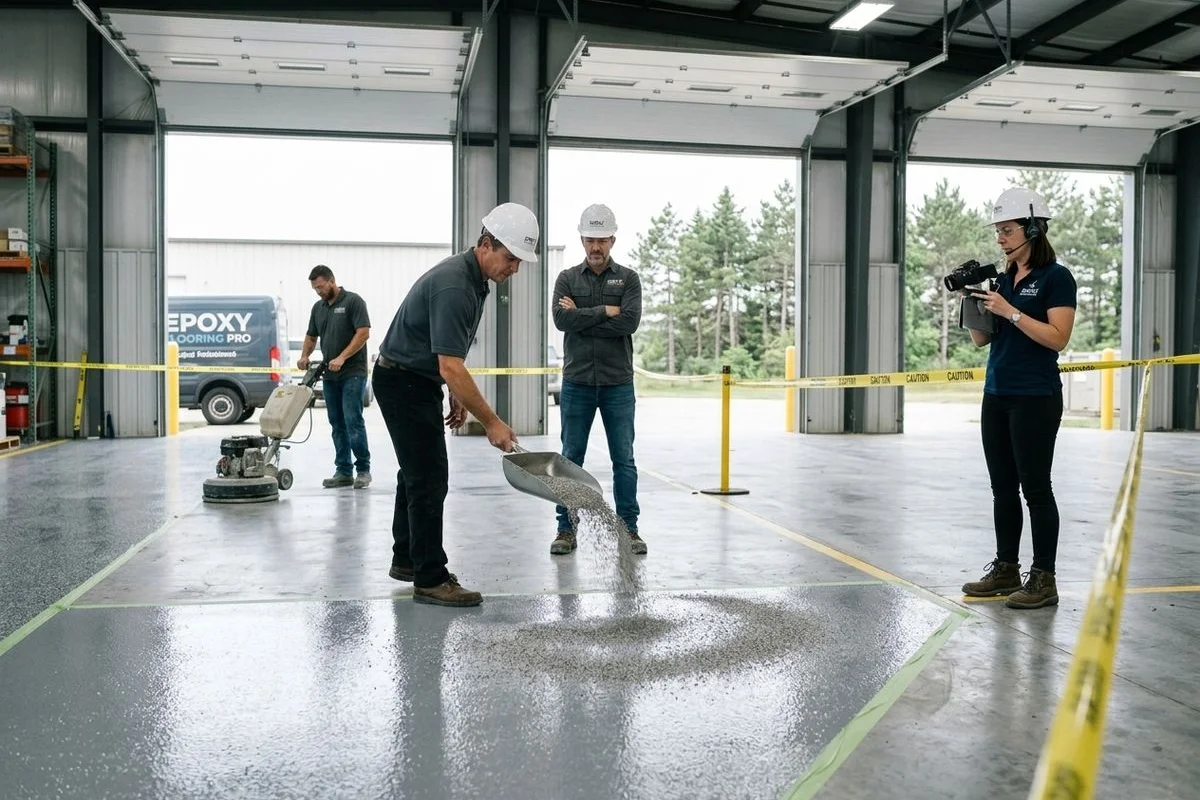
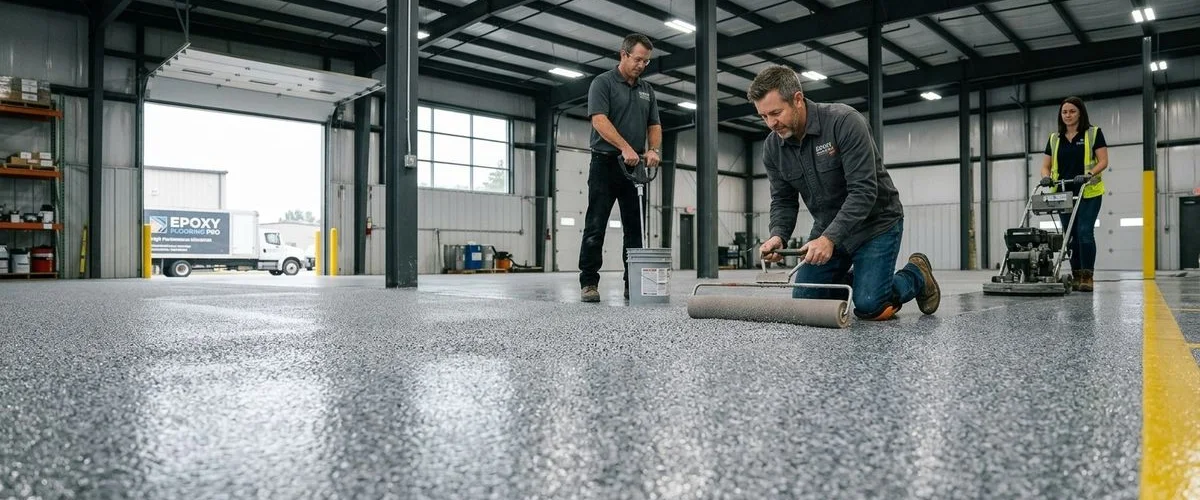
Aggregate broadcast is the most effective method for creating and maintaining high slip resistance in industrial floor coatings. The process involves broadcasting hard mineral aggregate — aluminum oxide, garnet, or silica — into a wet coating layer at a specified rate per square foot. The aggregate particles protrude from the cured coating surface, creating thousands of friction points per square inch.
Aluminum oxide aggregate is the preferred choice for Warren’s demanding industrial environments. It is one of the hardest minerals available commercially — second only to diamond — which means it resists wear exceptionally well and maintains its texture through years of heavy forklift traffic and foot traffic. Aluminum oxide aggregate broadcast is our standard specification for Warren food processing areas, loading docks, stair treads, ramp surfaces, and any area with wet or oily contamination.
Garnet aggregate provides slightly less aggressive texture than aluminum oxide but is still significantly harder than most floor coating binders. It is a good choice for Warren commercial environments where slightly less texture is preferred while still achieving required COF values.
Particle size selection is critical. Coarser aggregate creates higher initial slip resistance but also creates a surface that is harder to clean and more aggressive on footwear. We select particle size based on the required COF, the cleaning equipment used in your Warren facility, and the type of traffic — heavy forklift areas need different specifications than pedestrian-only zones.
Textured Topcoats: Moderate Slip Resistance
For environments where moderate slip resistance is required without the aggressive texture of aggregate broadcast, textured polyurethane and epoxy topcoat formulations provide a fine texture that improves grip over smooth finishes. These are appropriate for Warren office corridors, showroom floors, and environments where high COF is required but extreme texture is not practical.
Textured topcoats are also used as a “refresher” application over existing smooth coatings in good condition, providing improved slip resistance without complete recoating — a cost-effective solution for Warren facilities that need to address an OSHA concern quickly.
Testing and Documentation: Proving Compliance
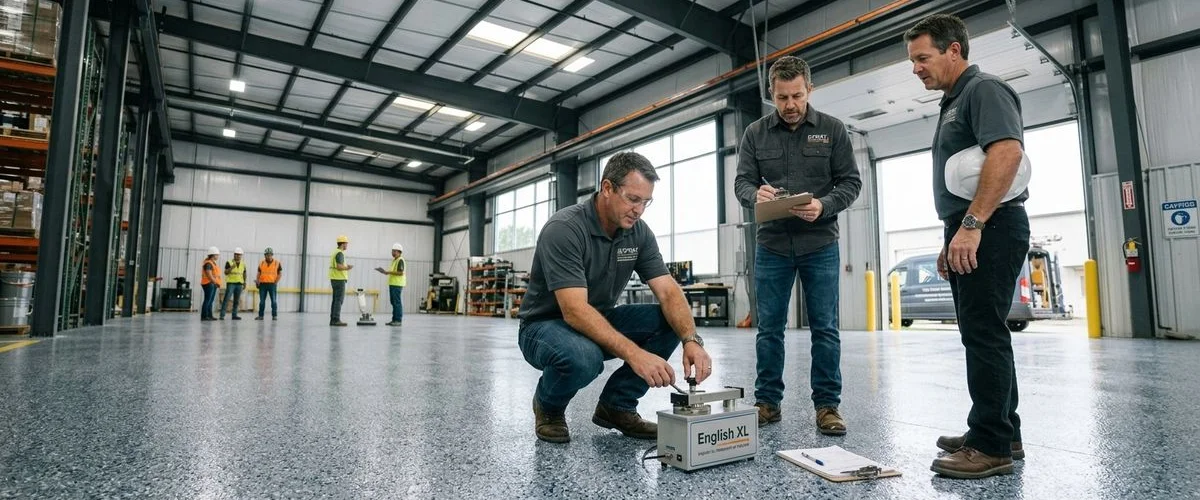
The difference between a floor that looks non-slip and a floor that is certified non-slip is documented testing. We test every non-slip installation using calibrated slip-resistance measurement equipment.
ASTM C1028 (Static COF Testing)
The Static Coefficient of Friction (SCOF) test uses a standardized neolite foot pad pulled across the floor surface under a controlled load. Results are reported as a static COF value that can be compared directly to OSHA guidance (0.5 minimum for level surfaces) and ANSI A1264.2 recommendations.
BOT-3000E Tribometer Testing
The BOT-3000E is a digital tribometer that measures both static and dynamic COF values under controlled wet and dry conditions. This automated testing method reduces operator variability and produces highly reproducible results. For Warren food processing and distribution facilities where wet-condition performance is critical, we test under the relevant wet condition.
Documentation for OSHA, MIOSHA, and Insurance Purposes
Test results are documented in a formal report that includes test method, conditions, results at multiple locations, and pass/fail determination. This documentation supports:
- OSHA General Duty Clause compliance: Demonstrates proactive identification and control of slip hazards
- MIOSHA compliance: Michigan’s state OSHA program enforces the same requirements — documented COF testing demonstrates due diligence
- ANSI A1264.2 compliance: Documents walking surface COF against ANSI recommendations
- Insurance underwriting: Many carriers request slip-resistance documentation for facilities with high pedestrian and forklift traffic
- Incident response: Pre-incident documentation of compliant slip resistance is valuable evidence if a slip-and-fall claim occurs
High-Risk Warren Environments We Serve
Food processing and distribution: Warren’s food distribution sector — including operations like Lipari Foods — creates extreme slip hazard conditions with wet floors, organic material contamination, and frequent chemical washdowns. We specify aggregate broadcast systems with food-safe topcoats that meet USDA and Macomb County health department requirements.
Loading docks and receiving areas: Warren warehouse loading docks on Mound Road and Van Dyke are transition zones where Michigan winter conditions — water, snow, ice melt, and road salt — combine with forklift traffic and product spills. Aggressive aluminum oxide broadcast systems with bright color designation are standard.
Automotive manufacturing and service: Warren’s concentration of automotive plants and Tier 1 suppliers means oil, coolant, and hydraulic fluid contamination on floors is constant. Non-slip broadcast systems provide grip even with petroleum contamination — critical for worker safety around heavy presses, stamping equipment, and assembly lines.
Chemical processing areas: Process spills, washdown water, and chemical condensate create slip hazards in Warren’s plating, anodizing, and chemical handling facilities. Chemical-resistant topcoats over aggregate broadcast combine slip resistance with chemical protection.
Contact Epoxy Flooring Pro to schedule a slip hazard assessment at your Warren facility. We will measure your current floor, identify high-risk zones, specify the appropriate non-slip system, and provide the documented COF testing that proves your floor is safe.
What's Included
Our Non-Slip Safety Coatings Installation Process
Slip Hazard Assessment
We assess the current floor surface, identify wet and oily zones, review incident records, and determine the required coefficient of friction for your specific environment and regulatory requirements.
Surface Preparation
Existing surface is cleaned, degreased, and abraded to ensure adequate adhesion for the new coating or topcoat. Oil and chemical contamination must be fully removed before any coating is applied.
Primer or Bonding Coat Application
A penetrating primer or bonding coat is applied to the prepared surface. For existing coatings in good condition, an adhesion-promoting bonding coat allows application without full removal.
Non-Slip Aggregate Broadcast
Aluminum oxide, garnet, or silica aggregate is broadcast into the wet coating at the specified rate per square foot. Aggregate type, particle size, and broadcast rate determine the final slip-resistance value.
Encapsulation and Topcoat
Broadcast aggregate is encapsulated with a clear or pigmented topcoat that locks particles in place and provides the chemical resistance and cleanability required for the environment.
Slip-Resistance Testing & Documentation
Completed surface is tested using calibrated slip-resistance equipment. Results are documented with COF values, test conditions, and pass/fail determination against your specified or regulatory requirement.
Why Choose Epoxy Flooring Pro
Verified COF Values, Not Just Texture
We test completed non-slip surfaces with calibrated equipment and provide documented coefficient of friction values. A surface that looks rough is not the same as a surface that meets OSHA or ANSI slip-resistance requirements.
Wet and Oily Condition Performance
A floor that is slip-resistant when dry but fails in wet or oily conditions provides false assurance. We specify and test systems for your actual use conditions — dry, wet, or oily — not ideal lab conditions.
OSHA Compliance Documentation
We provide test documentation that supports OSHA General Duty Clause compliance and ANSI A1264.2 recommendations for walking surface slip resistance. This documentation demonstrates due diligence in your safety program.
Retrofit Capability
In many cases, we can apply non-slip treatment to existing floor coatings in good condition without complete removal and recoating — significantly reducing cost and downtime.
What Our Clients Say
"We had three slip-and-fall incidents in our Warren food distribution center in one year — all in the receiving dock area where water and condensation made the smooth floor dangerously slippery. Epoxy Flooring Pro installed an aluminum oxide broadcast system and gave us documented COF testing. Zero incidents in the 18 months since installation."
"MIOSHA cited our Mound Road warehouse for slippery floors in the forklift traffic lanes. Epoxy Flooring Pro installed a non-slip coating, tested it with calibrated equipment, and provided the documentation we needed to close the citation. The floor works exactly as promised and our forklift operators appreciate the difference."
Frequently Asked Questions
What Warren industries have the highest slip-and-fall risk?
What is coefficient of friction (COF) and what values are required?
Can non-slip treatment be applied to an existing smooth epoxy floor in our Warren plant?
How do non-slip floors work in Warren's winter conditions?
Will a non-slip surface hold up with the chemical washdowns in our Warren food facility?
How long does a non-slip coating last in a Warren industrial environment?
Get a Free Estimate for Non-Slip Safety Coatings
Our project managers are ready to assess your facility and recommend the optimal non-slip safety coatings solution.